107 Silicone Rubber: α,ω-dihydroxy polydimethylsiloxane serves as the base rubber for both two-component and single-component condensation-type silicone rubbers, commonly referred to as 107 silicone rubber in the market. This raw rubber can be directly used as a commercial product or as an intermediate for producing various condensation-type silicone rubber products.

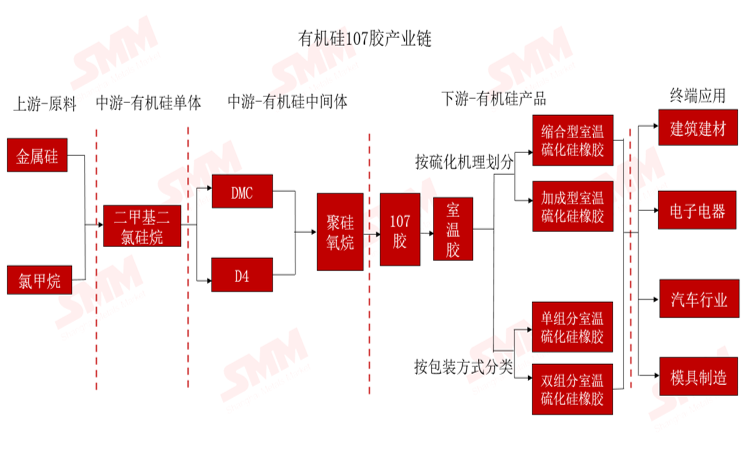
The 107 silicone rubber industry chain consists of five segments: upstream - raw materials, midstream - silicone monomers, midstream - silicone intermediates, downstream - silicone products, and end-use applications. Depending on the type of room-temperature vulcanized (RTV) rubber, the end-use sectors vary.
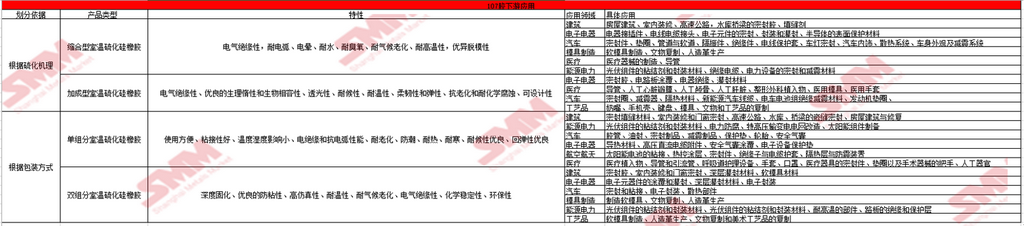
Specifically, as a downstream product of 107 silicone rubber, RTV rubber exhibits properties such as electrical insulation, arc resistance, corona resistance, excellent release properties, ozone resistance, high-temperature resistance, weather aging resistance, superior physiological inertness and biocompatibility, light transmittance, and adhesion. Its end-use applications span across the construction industry, automotive industry, medical industry, electronics and electrical appliances, energy and power, and mold manufacturing.
In the construction industry, RTV rubber is widely used for applications such as sealing building curtain walls and residential structures, as well as processing energy-efficient glass for doors and windows. It not only enhances the structural strength and rigidity of curtain walls but also fills expansion joints, providing excellent waterproofing and weather resistance. Additionally, RTV rubber is used for secondary sealing of insulated glass. Furthermore, it is extensively applied in sealing joints of high-rise building panels and interior walls, connections between door and window frames and glass, joints of precast concrete panels, marble, and other materials, as well as sealing joints in ultra-clean rooms and cold storage facilities.
In automotive manufacturing, RTV rubber is widely used for sealing gaskets and as an adhesive sealant for equipment. It offers excellent water resistance and lubrication oil resistance, making it suitable for various automotive components. On average, approximately 0.2 to 0.3 kilograms of RTV rubber are required per domestically produced vehicle, used for applications such as headlamps, engine hood damping, sealing between the engine and transmission, window bonding, and other sealing areas.
In the energy and power sector, RTV rubber is used as an encapsulation material for components and as an adhesive for PV modules in solar panel manufacturing. With the continued growth of the domestic PV power generation industry, its penetration rate in the PV market is accelerating.
RTV rubber finds extensive applications across various industries. In the electronics and radio industries, it is used for encapsulation, potting, and bonding, providing excellent protection for electronic components. In the aerospace sector, RTV rubber is an indispensable sealing material due to its high-temperature and corrosion resistance. In the medical industry, its non-toxic, physiologically inert, and biocompatible properties make it widely used in prosthetics and dental materials. The food industry utilizes RTV rubber's sealing properties to ensure the safety of containers and equipment, preventing contamination. Additionally, RTV rubber plays a significant role in cultural relic preservation and restoration, with its stable chemical properties ensuring no damage to artifacts.
Silicone materials are widely applied across almost all manufacturing industries, playing a fundamental and strategic role in both traditional and emerging strategic industries. With continuous advancements in industry-driven innovation, the silicone industry is poised to embrace new development opportunities and has a very promising outlook.
![[SMM Перевозки угля и кокса] Поставки угля в порты Китая на прошлой неделе составили 8,28 млн тонн, что на 3% больше по сравнению с предыдущей неделей и на 13% меньше по сравнению с аналогичным периодом прошлого года.](https://imgqn.smm.cn/usercenter/UqlZJ20251217171717.jpg)
![[Срочные новости SMM по углю] White Energy приобретет угольный проект South Galilee](https://imgqn.smm.cn/usercenter/tgoYV20251217171715.jpg)